01
Reporting & KPIs
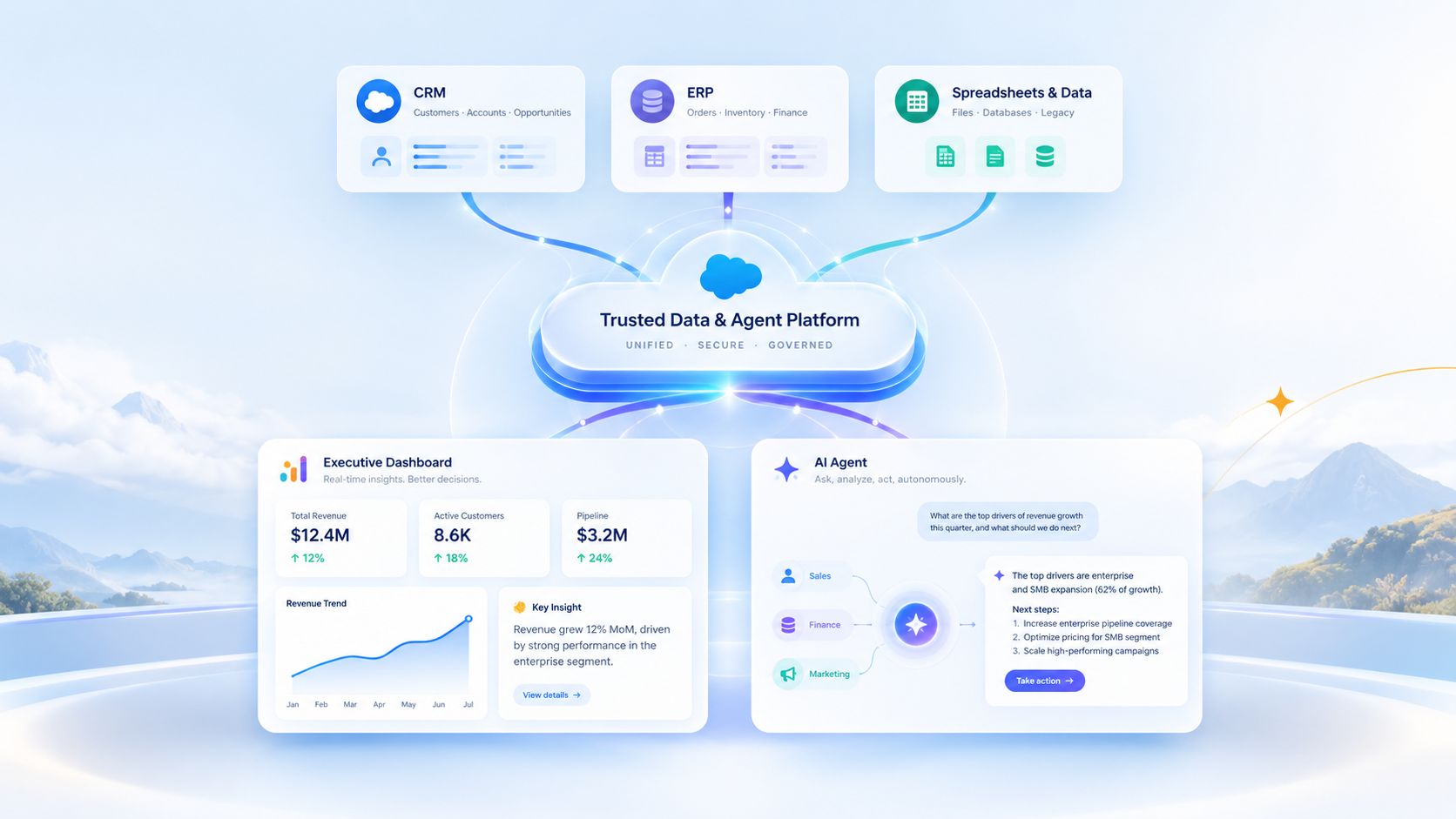
One agreed definition for every number, then dashboards built on it. Revenue, margin and backlog that match what accounting reports, so leadership uses the dashboard instead of arguing with it.
Salesforce & data consulting
We fix the data and the numbers, build what's missing, keep it secure, and run it every month. For midsize companies in Nebraska, Iowa, Kansas, Colorado and the wider Midwest.
Sound familiar?
Nobody goes shopping for Salesforce help. Something specific broke, and it keeps breaking on a schedule.
Your CRM and your financial system report different numbers, and nobody can say which one is right.
The reports exist. People check them, find something that looks wrong, and go back to making decisions on instinct.
The person who knew how it worked left. Requests pile up, small fixes wait for weeks, and nobody wants to touch the settings.
Over the years people connected tools to Salesforce. Nobody has checked which ones can still read your customer data, or who approved them.
Someone spends the first week of every month reconciling spreadsheets by hand, and it's the same week every month.
Deals stall and nobody notices until the quarter closes. There's no view of what's actually in the pipeline or how long it's been sitting there.
You bought the platform. Adoption stalled, the data model doesn't match how you work, and half the team went back to spreadsheets.
Work gets done in the field and recorded somewhere else: on paper, in a text, in someone’s head. What reaches the system is late and incomplete.
Also common Two of everything after an acquisition. Two CRMs, two chart-of-accounts structures, two definitions of a customer.
Ways to start
Each step stands on its own, and you keep what it produces whether or not you go further.
A scored review of how your Salesforce is set up and secured, a fix list with a price for every item, and a one-page summary for leadership.
What the audit coversWe interview your team, map how data moves today, and hand you a roadmap: what to fix, in what order, and an estimate for each phase.
How the diagnostic worksSomeone who knows your org handles requests, releases and security checks every month, for a set number of hours. Quoted after one call, from the size of your org.
See the plansNot sure which? Book a call and tell us what broke, or email us and we'll reply within one business day. We'll tell you which step fits, or whether you need us at all.
Builds can't be priced before we know what's needed, so the roadmap prices them one phase at a time. Every phase gets a written estimate and a ceiling before it starts. If we're heading past it, we stop and tell you first, and nothing over the approved amount is billed unless you sign for it. You can stop after any phase and keep what's built, and the diagnostic fee is credited to the first phase.
How it works
Most projects end at go-live. We stay, so what was built keeps working.
01 Assess
You get a roadmap with an estimate for each phase.
02 Build
Priced per phase, with a ceiling. Nothing over it is billed without your signature.
03 Run
From $1,500 a month. Managed services
Security runs through all three: checked in the assessment, designed into the build, and monitored every month. How we handle security
The diagnostic
Most failed projects are correctly built solutions to the wrong problem. A diagnostic is two to three weeks: we interview your team, map how data actually moves through your systems today, and hand you a roadmap of what to fix, in what order, with an estimate for each phase.
Fixed scope. Fixed price, agreed in writing before we start. No obligation after.
Week 1
We sit with the people doing the work, not just the people who own the budget.
Week 2
How data actually moves between your systems today, including the spreadsheets nobody mentions.
Weeks 2 to 3
What to fix, in what order, an estimate for each phase with a total range, and what could go wrong.
You keep
Phase estimates, sequencing, and a risk register. Yours whether or not we build it.
What we build
The diagnostic tells you what to fix. This is what then gets fixed, priced one phase at a time with a ceiling, and you approve each phase before work starts.
One agreed definition for every number, then dashboards built on it. Revenue, margin and backlog that match what accounting reports, so leadership uses the dashboard instead of arguing with it.
Data moved out of old CRMs, ERPs and spreadsheets into Salesforce, cleaned and checked along the way, so the numbers reconcile with finance from the first day.
Quotes, orders and pipeline in one place, calls and emails logged without anyone typing them up, and an alert when a deal stops moving.
Salesforce connected to your ERP, accounting, field and credit systems, so nobody re-types the same data in two places.
Field work recorded where it happens, and projects run inside Salesforce: schedules, Gantt charts and project charters generated for you.
We start with one job worth handing to an agent, for example a project manager asking which jobs are trending over budget and getting the same number accounting has. Then we build it, test it with real users and keep tuning it after launch. An agent is only as good as the data under it, so if yours is not ready, we fix that first.
Already been pitched Agentforce? Send us the proposal. For a fixed price, we'll tell you which jobs an agent would really do for your team, what it costs once usage starts, and whether your data is ready. If the answer is not yet, you get that in writing.
Platforms worked in daily
Who you'd be working with
Cottonwood is a new, founder-led firm. You deal directly with the architect who designs and builds your system. You meet them on the first call, names and certifications are shared before anyone gets access to your org, and specialists join larger projects only after you have met them.
We're a US company based in Omaha. We meet your team in person for kickoff, and again whenever it helps.
Working with
Midsize companies across Nebraska, Iowa, Kansas, Colorado and the wider Midwest.
Before you book
You tell us what broke and when it started. We ask enough questions to understand whether the problem is the data, the system, or the process. If a diagnostic isn't the right answer, we say so on the call.
Two to three weeks. We interview your team, map how data actually moves through your systems today, and hand you a roadmap of what to fix, in what order, with an estimate for each phase. Fixed scope, fixed price.
A written roadmap with an estimate for each phase and a risk register. You own the output. There is no obligation to have us build any of it.
It depends on what the diagnostic finds, so we don't quote a build before we understand it. The roadmap prices it one phase at a time: every phase gets a written estimate and a ceiling, and nothing over the ceiling is billed unless you sign for it. You can stop after any phase, and the diagnostic fee is credited to the first one. The security audit and the monthly plans have published starting prices, and the diagnostic's fixed price is agreed before you commit.
We stay if you want us to. A monthly managed service covers admin, the three Salesforce releases a year, security checks and small changes, with a set number of hours each month. The documentation of your org is yours whether or not you keep us.
Only named people from our team, each with their own login, through your single sign-on and multi-factor login, with only the permissions the work needs. Every login is recorded in your own Salesforce, and access is removed the same day you ask. We're a US company based in Omaha, and we meet your team in person for kickoff.
Yes. We answer the Salesforce sections with you (multi-factor login, outside apps with access to your data, who can export it) and give you the evidence: screenshots and settings exports.
Managed services start with three months, then run month to month with 30 days' notice. When you leave, you keep the documentation, credentials stay in your accounts, and our access is removed the same day.
Salesforce is the centre of most engagements, but the work spans migration from legacy CRM and ERP systems, REST and SOAP integration, Tableau and Power BI reporting, and native project management systems.
Yes. We start with one task worth handing to an agent, build and test it with your team, and keep tuning it after launch. If your data isn't ready for an agent, we tell you and fix that first. Already been pitched Agentforce? Send us the proposal for a fixed-price second opinion. We also connect Claude to your Salesforce and finance systems, so leadership can ask questions directly.
You work directly with our founder, a Salesforce certified architect, who designs and builds your system. You meet them on the first call, and names and certifications are shared before anyone gets access to your org. Specialists join larger projects only after you have met them.
Next step
Tell us what broke and when it started. If a diagnostic isn't the right answer, we'll say so on the call. There's no cost and no obligation.
The call is with the person who would do the work. No slides.
Rather start by email? Write to us with what broke and when it started, and we'll reply within one business day.
Insights
Set up Email-to-Case in Salesforce: what to decide first, the setup steps, forwarding from Microsoft 365 or Gmail, loop checks and a test plan.
Salesforce CPQ is end of sale, not end of life. What that means for your renewal, how to list what your quoting setup does, and how to pick a path.
Salesforce consultant vs partner explained: what partner tiers and specializations measure, when one independent consultant is enough, and how to check either.
Why your Salesforce Outlook integration is not syncing in 2026: which Outlook tool you run, the changes that broke it, and a short triage for your team.
What the Salesforce Field Service mobile app does offline, what waits for signal, how priming decides what the phone holds, and how to test it.
Let's talk. No deck, no obligation.
Book a call